As part of our ongoing strategic planning work with The National Charter Schools Institute, our Education Division has been taking time to reconnect with our “why”—the personal purpose that drives each of us in education. This reflection has reminded us that behind every role and every initiative are powerful stories rooted in service to students and schools. We’re excited to share those stories through our Sponsor Updates.
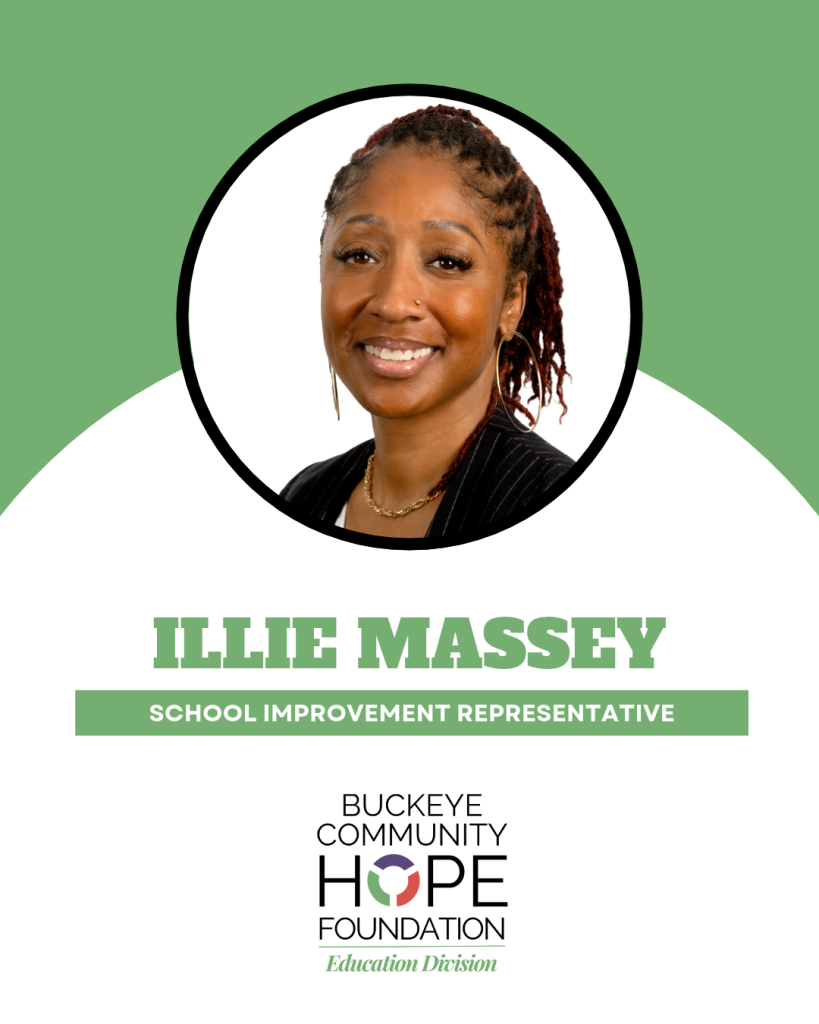
This month, we are featuring Illie Massey, Accountability and School Improvement Representative.
Can you give an overview of your background? What originally drew you to a career in education?
I grew up in Cleveland and attended public schools from preschool through 12th grade. I was relatively smart, but I didn’t always apply myself, and my GPA reflected that. I was actually discouraged by school administrators from applying to college because they didn’t think I would get in. I applied anyway and ended up getting a scholarship. Although, the administrators doubted my ability, my mom always made it clear to me that continuing my education was not really a choice. I was going to college. That experience has stayed with me throughout my career.
I started my career as a teacher and have worked in several different roles in education since then. Now, I’m in the final semester of my doctoral program. For me, education has always been a lifeline. And when I refer to education, I don’t just mean a four-year college. I mean two-year colleges, universities, trades, certifications, and training. There are so many paths. I believe every student should leave high school with access to a path that allows them to support themselves and build the life they want.
What motivates you to come to work every day?
Knowing that the work we do ultimately impacts students. I’m not in a classroom anymore, but I still get to support the people and systems that directly impact students. I’m especially passionate about equity and making sure students have access to what they need to be successful, regardless of where they come from or what they’ve experienced.
What do you enjoy most about your role at BCHF?
I enjoy being able to work with different schools and school leaders. Every school is different, so the work is never really the same. I like looking at data, asking questions, identifying where there may be gaps, and then working with schools to figure out what we can actually do about those gaps. I also appreciate that my role allows me to support schools without losing sight of the students behind the numbers.
How do you define your “why”? Is there a particular moment or experience that reinforced your “why”?
My why is really about access and opportunity. I know personally what it feels like to have someone look at your GPA or your circumstances and make assumptions about what you are capable of. I also know how much it matters to have someone who believes there are still possibilities for you.
One area I’m especially passionate about is trauma and how it impacts students and their educational experiences. My doctoral research focuses on historical and intergenerational trauma and the educational experiences of Black students. I think sometimes we focus so much on student behavior or academic performance that we don’t stop and ask what may be underneath it. For me, the question is always what can we do differently as educators and as systems to help mitigate some of those effects and give students a real opportunity to be successful.
How do you reconnect with your “why” during tough times?
I try to remember that there is a student on the other side of the work. It is easy to get caught up in reports, data, compliance, meetings, and everything else that comes with education. But ultimately, there’s a student who’s impacted by the decisions adults make. Remembering that helps me put things back into perspective.
What have you learned about yourself through your work at BCHF?
I have learned that I’m much more comfortable asking difficult questions than I used to be. I’ve also learned that I don’t always have to have the answers, and that’s okay. Sometimes my role is to ask the right questions, listen, look at what the data is telling us, and help people think through what comes next.
A quote or mantra you live by?
“Education is the practice of freedom.” – Bell Hooks
That really connects to how I see education. Education should open doors and create possibilities.
Who inspires you in your work?
The students and educators doing the work every day inspire me. I’m especially inspired by educators who continue to see possibility in students, even when those students are struggling. I think students need adults who can see beyond what’s happening in that moment and recognize who they can become.
Who are you outside of your work?
Outside of BCHF, I’m a mom, a doctoral student, and someone who really values my family and the people close to me. I love reading, traveling, and spending time with my family. We take a family vacation every year, which is probably my favorite tradition. I’m naturally pretty introverted, so I also really enjoy quiet time, a good book, and just being able to slow down and sit on my porch with a good book when I can.
Illie’s story is a powerful reminder of what can happen when someone chooses to believe in a student’s potential, even when others may see only a GPA, a challenge, or a circumstance. Her commitment to equity, access, and asking the questions that help schools better serve students reflects the heart of our Education Division and our shared “why.”