Our Education Division has been working on strategic planning with The National Charter Schools Institute. A key part of the experience has been reconnecting with our “why” in education, a reflection on the personal purpose that drives our work. We’re excited to share our stories in upcoming Sponsor Updates.
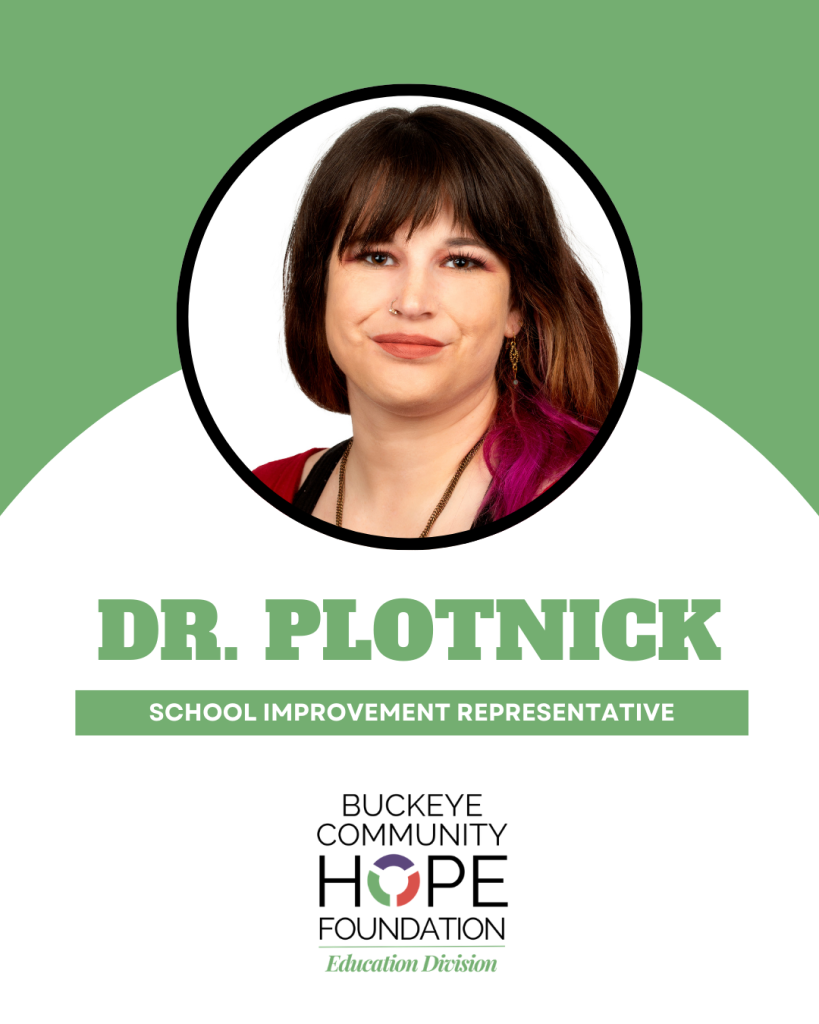
This month, we’re featuring Dr. Zoe Plotnick, School Improvement Representative.
What originally drew you to a career in education?
If someone in my family had made a list of every response I’d ever given when an adult asked what I wanted to be when I grew up, the professions on it would have been all over the place! But they didn’t have to dig far to uncover the common thread that was education. Like, I wanted to be an artist, but my vision of that always included teaching art classes. Then I wanted to be a writer, because I wanted to write the kinds of books that were transformational to me when I was a kid. When I started undergrad, I started out with a math major and ended up finishing an English degree with a concentration on pre-Renaissance literature. I changed majors, sometimes hopping between drastically different disciplines, but at any given time when pressed about what I’d actually be doing with that degree? “Well, I suppose I’ll probably end up teaching.” By random chance my first internship in my ELA licensure program placed me in the district’s international middle school, where 75 languages were spoken and more than a third of the students were refugees, on day one I thought, “Okay, so now I need to come back for a master’s because this is the population I have to work with.” I also worked under supplemental licensure as an IS and Title I intervention teacher for a little while, which was the result of events that I’d also have to characterize as a happy accident.
What motivates you to come to work every day?
The people I work with inspire me! I don’t think I’ve ever walked away from a conversation with Education Division colleagues without having learned something new. Talking with students and staff in our schools is also energizing.
What do you enjoy most about your role at BCHF?
Every day is different, and there is always something new to learn. Whenever I stumble upon a really fascinating topic or story related to K-12 education, I am almost always able to channel it back into my work in one way or another – maybe the book I just read will fuel the creation of a new seminar for our Frontline catalog, or I’ll remember something I learned from a linguistics professor’s podcast that inspires brainstorming questions for my EL teacher cohort.
How do you define your “why”? Is there a particular moment that reinforced it?
Something memorable that reinforced my “why” at work was when I was interviewing students in some of our credit recovery schools as part of my dissertation study. When BCHF first added me to the team as the content specialist for multilingual learners I didn’t know a huge amount about alternative high schools, but the experience helped me articulate the overarching “why” that brought me into K-12 education: I’ve always been drawn to working with the kinds of kids who the teachers’ edition usually relegated to a little gray box or infographic somewhere in the margin – as a neurodivergent person, I’ve probably always kind of identified a bit with these kids – because I’d like to imagine contributing to a world where schools open up possibilities for every kid, with no gray boxes that explain how to force square pegs fit into round holes needed. All holes for all pegs, all the time! Now I’m rambling.
How do you reconnect with your “why” during tough times?
Something I started doing last year was whenever someone said something to me that made me feel like I was doing or contributing something valuable – or even just anytime I receive a nice compliment – I write it down and save it to a digital notebook of nice things. Then whenever I’m feeling crummy and despondent, I look at it and remind myself that I need to keep at it. I would recommend this practice to anybody, really.
What have you learned about yourself through your work at BCHF?
A lot! Most of all, though, I’ve surprised myself with how many new things I’ve learned how to do since I started in this role. If you’d told me five years ago that I’d be leading professional development for an audience of school principals and submitting articles to leadership education journals I’ve had been like, Not a chance, lol. My dissertation chair invited me to drop in as a guest in one of his classes at UNM a few weeks ago to talk about a paper we were working on, and I’m still not over reading phrases like, “According to Plotnick et al. (2025)…” among the questions he sent from his students while we were preparing.
How do you hope to continue growing in your role?
This year I’ve started representing BCHF while presenting at conferences, which has allowed me to connect and exchange ideas with people outside the usual Ohio authorizer spaces. Right now I’m getting ready to go present at RAPSA Forum in San Diego, so I’m excited about all the new ideas and questions and solutions that I’ll be able to bring back to BCHF.
What is a quote or mantra you live by?
“Education is the most powerful weapon which you can use to change the world.” – Nelson Mandela
Who inspires you in your work?
In no particular order: Lisa Delpit, Shirley Brice Heath, Anthony Muhammad, Valentina Gonazalez, Jal Mehta, Derek Black, Zaretta Hammond, Ernest Morrell. Also, this is corny and cliché, but I don’t care: my 14-year-old daughter Sophie. I do this work because I think she’s pretty awesome, so I want her to inherit the best version of our world that is possible.
Who are you outside of your work at BCHF?
I live with my daughter and my manfriend, and we’ve had to turn our basement into one big crafting space so that all our various different art projects don’t take over the rest of the house. Lately I’ve been experimenting with cyanotype prints – most people think of those kits where you put leaves and random objects on paper, leave it in the sun for 10 minutes and then rinse to get these white silhouettes on blue backdrop, but I’ve been having fun messing around with layering ink drawings on transparency paper. I also co-direct a regional arts festival, do fortunetelling with Pokemon cards, and take different dance classes. I’m trying to learn how to do tricks in an aerial hoop, I really suck at it but it’s a lot of fun anyway. I think that’s it!
Whether in her art, her scholarship, or her school improvement work, Dr. Zoe Plotnick brings imagination, intellect, and heart to everything she does.